- Emergent AI
- Posts
- On frothiness and utility
On frothiness and utility
Two things can be true: AI is a bubble and useful

Ilan Man
November 05, 2025
A recent post I wrote on LinkedIn went viral:
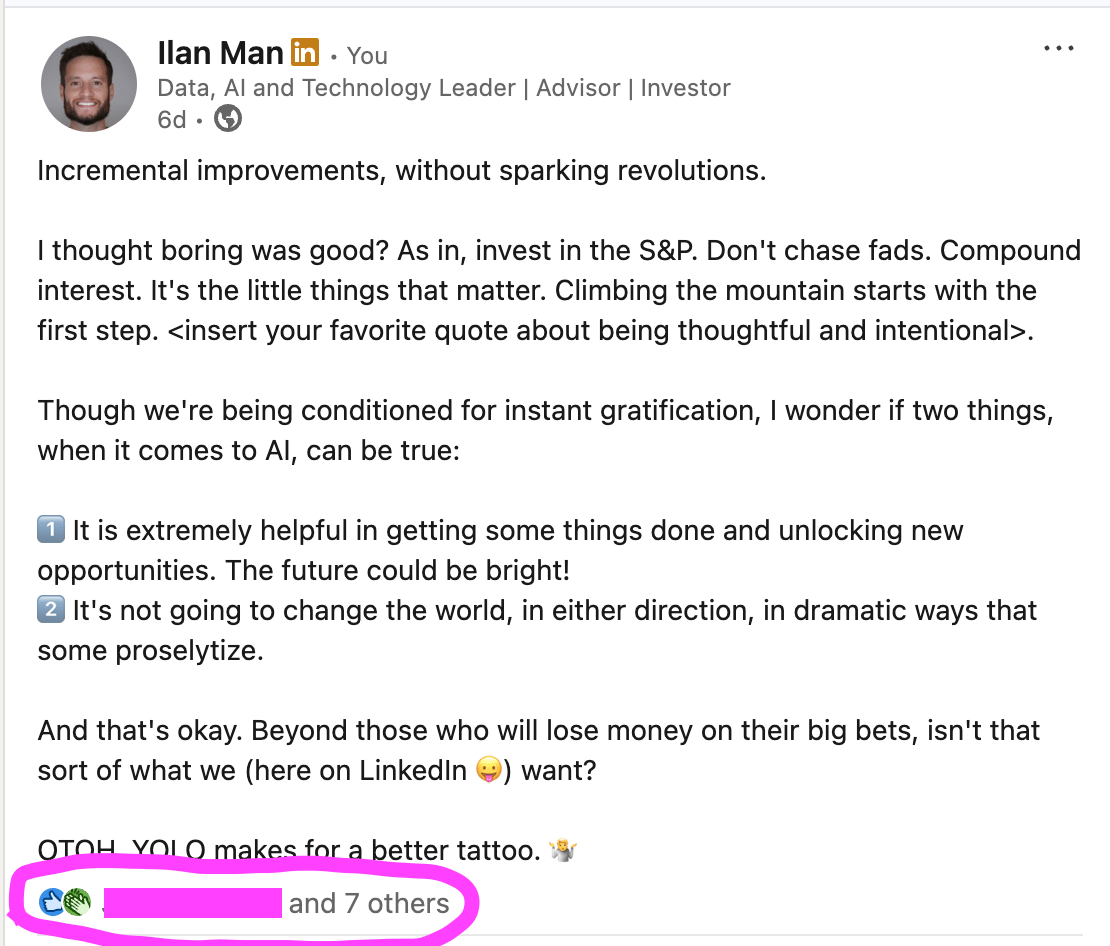
I’m sure you’ve seen it 😃
I wrote it in response to friends asking me if I think this AI thing is a bubble or not, and if so, how seriously they should take it. And my annoying answer, is yes.1
To be clear, as far as financial indicators are concerned, AI is a bubble.2 Here are some popular bubble indicators:
Companies are wildly overvalued relative to how much money they earn.3
A handful of firms invest in each other, further pumping up their stock price.
Powerful people, companies and governments are vested in making sure this thing pans out. This adds even more fuel (e.g. leverage) to the fire.
In the past, shoe shine boys and taxi drivers gave you stock tips; today, everyone you know is building an AI-app or selling you AI services.4
Beyond companies directly invested in or building AI, adjacent companies and industries are also intertwined (e.g. correlated or systemic risk)
So yeah, the flashing signs are there for AI (and by extension, the market itself) to correct.5 On the other hand, does that mean AI won’t be transformative? No it doesn’t.6
Why do we care & talk about bubbles?
Bubbles require a lot of people rowing in the same direction
In short, a bubble occurs when people think companies (or tulips) are worth more than they should be. But, like, a lot more. And not just some folks on the fringe - a large portion of the investment community. That in and of itself isn’t bad - who among us hasn’t gotten a little over eager for something, willing it to be, but knowing deep down it wasn’t meant to be. I’m not above some FOMO.
The market is a deeply connected system
The next ingredient: dependencies. Bubbles don’t happen in a vacuum. While the center of gravity may be a handful of AI companies, they are intertwined with a bunch of smaller companies, suppliers, data centers, clients, regulators. It’s a hype economy. So now we’re inflating the value and expectations of one industry that has a lot of second and third degree relations. And so on. Like a virus!7
Investments should yield a return
The problem is that eventually, people want their money back.8 And that means profits.9 It’s not sustainable to keep driving prices up. It gets too expensive, people get jittery, and the house of cards comes crumbling down - first slowly, then immediately. And when that happens, everyone who bought the stock on the way up is left holding something that is worth fractions of what they thought.
And when we don’t get our money back, bad stuff happens
When almost everyone (people, companies, governments) loses money (on paper) that has huge ramifications for their ability to take a loan, pay back debt, convert that paper money to real money, etc. All sorts of bad stuff - the wider the bubble, the worse the impact on everyone. We read about it during the great depression, and many of us lived it during the great recession.10

Source: Reuters
Two things can be true at the same time
Fine, let’s say AI is a bubble.11 For those who have bet their reputation, or are trying to get rich quick, this matters because at some point, they’ll need to justify their investments or valuations (see above: eventually people want their money back).12
And since these insiders keep investing at higher and higher valuations, they need AI to be world changing, not simply useful. They need it to be revolutionary, not incrementally better. This is the narrative that dominates the news cycle and my LI feed.
However, once you separate the narrative from the product, you’ll find that AI is and will most likely be increasingly useful!13 Here’s why I think so:
It’s not a new phenomenon - artificial intelligence as a field has been around for ~70 years. Lots of people have been thinking about this for a while.
It’s not a completely new paradigm - using computers to process data faster than we ever could is sort of obviously where we’re trending right?14
Applications of AI are very broad - from generating content on the low end, through to the singularity on the high end. We’re only a few years into the current iteration of AI, and its already helpful.15
It doesn’t require extra magic or a leap of faith16 - it requires data (all around us waiting to be digitized), algorithms (humans, and now computers, love devising efficient instructions) and compute (which used to require calories, now requires energy). It’s the same as it ever was.
Fundamentally, there’s a lot going for AI. But here’s the funny thing: folks pumping it up need to extrapolate from its capabilities today (help write a research report) to what it could do (enable space travel) to keep up excitement and goose valuations. I get it, that’s the job. The downside is it leads to the bubble mania described above.
It’s hard for me to get excited about automating workflows or using agents to book my flight (although it’s really fun to watch it write code in front of my eyes). I’ll get excited when someone cures cancer with AI, or robots can reliably navigate our world, but until then, yawn.
MBGA: Make Boring Great Again
Yawn is good! Yawn is progress! Yawn is useful!
But Yawn doesn’t generate billions of investment. Yawn doesn’t lead to a $5 trillion valuation. Yawn doesn’t deliver $100M ARR in 8 months.17 Yawn doesn’t create cloud cover to correct for overhiring. And it doesn’t influence geopolitical policy.
So be aware when reading the headlines and the influencers. Don’t throw the baby out with the bathwater.18 AI can be extremely useful and productive, and also overblown. AI may change the world. AI may alter what work is and who does it. Everyone associated with AI may climb up and up, floating higher and higher. And they may also pop like a bubble. In the meantime, keep your head down, do the work, play with the tools, have fun with it, and don’t take it all so seriously. Life’s too short!
1 It’s never simple is it.
2 You come here for the latest controversial takes right?
3 When it happens to individual companies, we call those meme stocks. When it happens to broad segments of the market that can bring it all down, we call that a bubble.
4 The irony of me being an AI consultant isn’t lost on me (hoping my ML and data background gives me some cred!).
5 To be fair, economists aren’t known for predicting recessions.
6 Apologies for the double negative, but here we are.
7 It sounds like I’m happy, but it’s very serious! This is my serious voice!
8 Venture capital’s largest customers (aka LPs, or limited partners) are pension funds, university endowments and sovereign wealth funds due to their scale and long term mindset.
9 It’s actually not even profits per se, its the expectation of profits. We know well in advance if the investment is going to bear fruit. We don’t need to wait until we ask for our money back to realize we’ve been overvaluing companies for years. Here’s the rub: can you figure this out before others? And when you do, do the rest of us believe you, causing the bottom to fall out? A similar collective panic: bank runs. You want to be first, not last, to take your money out.
10 Put aside the ~12 year bull run post great recession.
11 I mean, even this guy thinks so.
12 If you’re one of these guys, you’re likely rich and won’t be receiving much sympathy.
13 The dot com bubble did leave us with Google, Amazon and the modern internet after all. Also, Ben Thompson is trying hard to make a bullish case.
14 Yes there are knock on effects (collecting more data than ever before, putting people out of work, etc.) but at bottom, the AI we’re talking about is just (just is doing a lot of work here) that - using data to make predictions faster than humans can. It’s pattern recognition (something very human) on a massive scale. How we use those predictions, that’s where things can get really interesting.
15 Albeit marginally so - if it went away, the world would snap back to pre-2022 levels pretty quickly (though developers would need to re-learn coding syntax).
16 Things that require faith or a completely new paradigm: sustainable climate change solutions, quantum computing, nuclear fusion, healthcare that works for most people most of the time, colonizing Mars, etc. Compared to that, AI seems very pedestrian.
17 Let’s ignore that to calculate the A in ARR you probably should have at least 12 months of RR 🙃 I understand extrapolation, but I also understand we aren’t very good at it.
18 I’d prefer “"separate the wheat from the chaff” if I knew what chaff was.
Reply