- Emergent AI
- Posts
- Where are all the slide monkeys?
Where are all the slide monkeys?
Showing more, talking less.

Ilan Man
November 24, 2025

Are we done with 100 slide Powerpoint decks?
Yea: With AI replacing junior consultants, we no longer have to pretend to justify the cost of a consulting project by pointing to all the beautifully designed slides. We can instead focus on the value created by the project.1
Nay: With AI replacing junior consultants, making slides is easier & cheaper than ever, and by abusing Jevon’s paradox, when something is easier & cheaper, it is produced & consumed in greater volumes.
How does a deck even get that large?
When MBB gets hired for an 8 week strategy project for $250K, their deliverable is a Powerpoint presentation. Internet snark informs us that they charge $2000 per slide, so they need to deliver roughly 125 slides.2
Online memes aside, a standard consulting discovery / strategy project looks like:3
Hypothesis generation, “our feature velocity is slow because we’re drowning in tech debt”
Conducting interviews with a group of stakeholders
Reviewing existing processes, reports, and documentation.
Diving into technology and infrastructure (including talking with...developers!)4
Aligning on goals, direction and vision with the client
Drafting findings and recommendations report, “what do we need to do to get from today to the future?”
Mapping those recommendations onto a roadmap, “Now, Next, Later”
Beyond the work involved in the above (to be fair, there’s a lot going into that), and the final set of recommendations to be made, it’s expected that you bring receipts. Which sounds reasonable.5 This is also how you end up with 125 page slide deck.
Unfortunately, decision makers never read beyond the executive summary; if you’re lucky, they read the “Next Steps”. So in effect, you aren’t charging $2000 per slide; it’s more like $50K for 5 slides, and $0 for the remaining 120.
That seems unreasonably high! Unless…maybe 100% of the value derived from the $250K project is distilled in the 5 slides?6 Which begs the question - could we do without all those other slides, especially when we use AI to generate the supporting evidence slides?
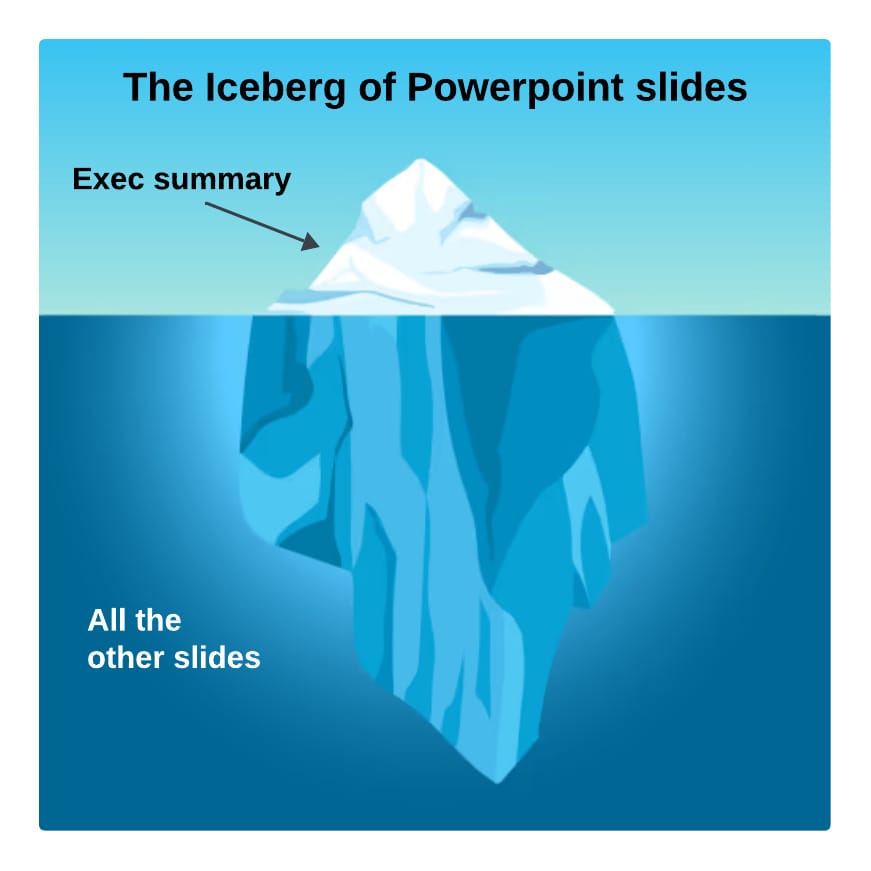
Is there anything this metaphor can’t be used for?
Who (What?) is making that content?
Junior (read: cheaper) consultants are drafting most of the content. Partners (VPs, MDs, etc) craft the narrative and identify the end state.7 Everything else is supporting evidence, but by the end of the project, if you’ve done your job right, the client already knows what’s up. No surprises. No big reveals. You should bring them along the journey throughout the engagement.8 During the presentation the question is less “show me everything you did in the past 2 months” and more “what do you recommend we do next?”.
That said, I still believe there’s non-zero value to show evidence (by way of slides - but I’m all ears for another way!) in case it comes up.9 Moreover, in general the process of putting content together helps to refine one’s message. It’s also a way to give your client stakeholders a voice in the process (“See that slide, that was based on my feedback!”). People feel seen. You’ve done a good job, not just delivering the project, but being a good partner.
Clients understand that a small army of juniors created all these slides, and were happy willing to pay for it.10 Now, what if that army of consultants was an army of AI agents? Are we still satisfied with the deck? Or, as I believe, are we more likely to ignore the contents and focus on the executive summary / next steps, i.e. the only slides that matter but now we don’t even pretend to care about the rest?
And if so, how does that change pricing? Am I, as a client, content to continue paying $250K for the discovery engagement or am I asking for a steep discount, knowing that 120 of the 125 slides being developed will cost a fraction of the price?
Let’s refocus how we talk about value
I believe rather than prices coming down, deliverables will increase.
That architecture review that was originally out of scope? That’s included.
The POC that was an additional 4 week exercise? That’s being run in parallel.
The 125 page slide deck? That’ll shrink down to the core 5 slides.11
We’ll be doing more showing, less telling. More building, less talking.12
The hours spent crafting slides will now be spent doing, you know, whatever consultants do outside of deck-work. Not a single person I’ve ever spoken to thinks the value created by a consulting project is the monster deck.
So why do we continue measuring that? It’s lazy to correlate slide count with value delivered. I believe the professional services industry needs to move away from that yardstick. I’m not advocating for completely abolishing slides, but I am hoping the performative exercise of showing clients all the work that we did goes away, that we focus more on the core message, and get to building.
And if your agency isn’t able to move fast enough to justify additional value-added work beyond the strategy deck, then you’ll find your sales pipeline dry up, your clients unhappy, and technical, boutique agencies that can build quickly with AI AND deliver executive strategy eating your lunch.
1 Heads up, the word value shows up a lot in this post. It’s lost all meaning to me by this point, which, if you finish this post, will be a very meta thing.
2 Or did I get the causation backwards?
3 There are a lot of flavors of this stuff (a cottage industry, if you will). And each one has a name. For example, Gap Analysis or The Cone of Uncertainty or The Cliffs of Insanity.
4 Inside baseball, but this is typically not in scope for pure strategy projects. You should push for it anyway!
5 After all, isn’t “showing your work” a keystone of our educational system? If we’ve abandoned that then my kids are going to be really angry with me…
6 This formulation is misleading - the answer is wholeheartedly yes, the entire project value is oftentimes these 5 slides.
7 They do much more of course, including generating opportunities for future work (such as the implementation phase which comes after the strategy project if you’re lucky).
8 For the consulting nerds out there, check out some of my earlier LI articles for tips on how to effectively deliver projects!
9 To be clear, execs pay you for your vibes (seriously, they do) but only when they trust you, and that trust is built on a track record. Until then, bring the data just in case.
10 I imagine there’s something satisfying about knowing that a team of future leaders spent many hours, evenings, and weekends pouring over this deck for you. And you won’t even read it? What a power move!
11 Downsizing from 125 → 5 is serious big deck energy.
12 I promise this line wasn’t written by ChatGPT (though admitting that is a questionable decision on my part…)
Reply